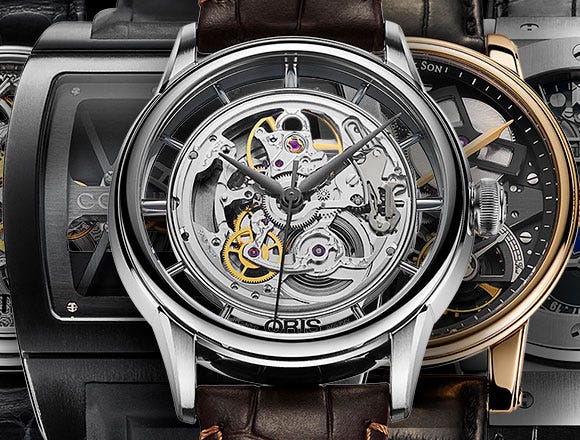
A mechanical watch can cost less than £1,000, and a mechanical watch can also cost more than £100,000. For something so small, can there really be such a difference to warrant such a disparity in cost? To answer that question, we've assembled a group of three watches—starting with this Nomos Glashütte—and we're going to see just how much value you get.
Watch our video review of the Nomos Glashütte Club Automat Datum 774, Jaeger-LeCoultre Master Ultra Thin Moon 1368420 and A. Lange & Söhne Saxonia Langematik Perpetual 310.025
Nomos Glashütte Club Automat Datum 774
This is the Nomos Club, a German watch and our entry-level example. As entry-level watches go, it's considered one of the best, boasting its own Zeta movement where many of its competitors use third party units. Nomos has invested a lot of money to give itself independence from the usual suspects of bulk movement manufacture, notably spending over £10 million on the development of its own escapement system.

Nomos offers an affordable in-house option with the Club Datum
Nomos makes no bones about the high-tech manufacturing techniques it uses to achieve such a high spec for such surprising value. Some small parts like jewels and springs are outsourced, built to the brand's specification, while components produced in-house are done so by machine, in many cases including the finish.
This modern method of production is what makes the price so competitive. If Nomos, a company employing only a few hundred people, were to swing the pendulum on hand versus machine manufacture, the cost would go up significantly. Nomos is more than willing to demonstrate what it can do with more human input with its Lambda collection—at a penalty of decimal place shift in the cost.

The Zeta movement inside is designed and built in-house by Nomos
While we'd all love to own a hand-finished masterpiece, the cost and time of reproducing something like that is far too prohibitive for the price point of this Nomos. With the alternative being something mass-produced and aesthetically uninteresting, being able to enjoy blued screws, Geneva striping, machine turning and bevelled edges for such a relatively affordable price point makes the argument for modern production methods all the more difficult to resist.
Jaeger-LeCoultre Master Ultra Thin Moon 1368420
Jaeger-LeCoultre has long been known as a watchmaker that provides superb value, straddling the line between midrange brands like Rolex and Omega, and the high-end masters such as Patek Philippe and Vacheron Constantin. In the way the Nomos punches above its weight at the lower end of the scale, the Jaeger-LeCoultre does the same at its price point of around £8,000.

Jaeger-LeCoultre offers a test of ultra high-end watchmaking for the price of a Rolex
This Master Ultra Thin Moon adds a moonphase to its shimmering dial over the time and date display of the Nomos, but it's the movement we're really interested in here. What exactly does spending over three times as much as the Nomos unleash?
Immediately, the finish is finer and more precise than the Nomos—that's because the human element has become a factor. The circular graining, for example, is applied by hand, and this takes far longer than it would a machine, which increases the cost. It's also—counterintuitively—a better result than one produced by machine, as the skillset of the most experienced watchmakers continues to outperform their mechanical counterparts.

Inside the Jaeger-LeCoultre is a hand-finished movement tested for 1,000 hours
Looking closer, it becomes more apparent as to why: these are complex processes that have been developed over hundreds of years to be applied by the human hand, with many different techniques used over the course of the finishing that rely on the subtleties of the watchmaker’s judgement. It's the ability to constantly adapt that's keeping the human brain one step ahead of the machine here.
It's remarkable just how much Jaeger-LeCoultre is offering with the Ultra Thin Moon. A quick leaf through a catalogue demonstrates that Jaeger-LeCoultre, like Nomos, will happily demonstrate just how far it take can take its watchmaking abilities, but it's here in the more affordable end of its collection that some of its most impressive work lies.
A. Lange & Söhne Saxonia Langematik Perpetual 310.025
Granted, our second German here, an £80,000 A. Lange & Söhne , is a perpetual calendar, which gives it the ability to keep track of the day, date, month and year—including leap years up to the year 2100—but it's a fine example of what you'll get in a money-no-object exercise to build a watch. This is at the pinnacle of what's possible when it comes to quality—at a premium, of course.

A. Lange & Söhne is the cream of German watchmaking
Seeing the calibre L922.1 is like seeing high-definition television for the first time. It's more crisp, more colourful, more detailed; it's a genuinely eye-opening thing to behold. And it should be. The German silver used for the plates and bridges has a warmth that contrasts well against the blued screws, the gold rotor and its platinum weight, just as the mirror-finished elements shine bright against the stripes and circles that have all been applied by hand.
But that's only the start. A closer look only further demonstrates how impressive the work is. Where the Jaeger-LeCoultre has some hand bevelling, virtually everything here is bevelled, a time-consuming process to do at all, let alone to this standard. It's all about the gloss, with a mirror-like edge achieved through repeated applications of increasingly fine abrasives until the surface is flawless. It takes time, and patience. Lots and lots of patience.
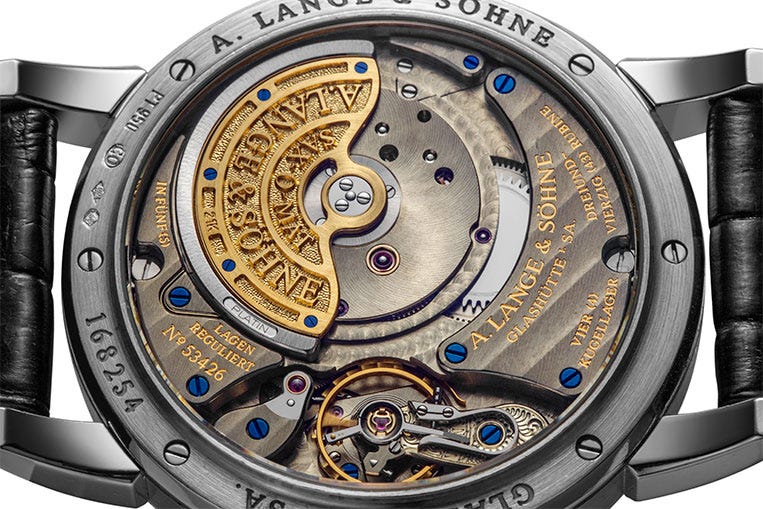
The finish of the calibre L922.1 is world class
Looking closer still impresses further, with elements that are, at this point, virtually invisible to the naked eye receiving the same level of attention as the elements that are. Remember, this entire frame is less than a centimetre in width—and it's an area that's received hundreds of hours of the most skilled attention just in itself. Even at this scale it's hard to believe that the engraved balance cock is unique to each watch, carved by hand with nothing more than a sharp piece of hardened steel and a microscope, a single process that takes as much as 90 hours to complete.
As the old expression goes, time is money, and it's the time that goes not only into manufacturing a movement, but also the time that goes into perfecting the skills to do so that spans the divide between each watch here. It's incredible to witness the result of the work of such talented artisans, who have been given the opportunity to push their abilities to the limit, but it's also incredible to see what can be achieved through smart thinking and modern techniques to make desirable watchmaking affordable. After all, the most impressive achievements are most often not the ones accomplished through prosperity, but the ones accomplished through adversity.
Looking for a Nomos watch? Click here to shop now
Looking for a Jaeger LeCoutre watch? Click here to shop now
Looking for an A. Lange & Söhne watch? Click here to shop now